If you have spent any time in the menstrual health world, you have almost certainly heard of seed cycling. And if you have spent any time trying to understand it, you have probably also run into a lot of confusing and contradictory information about which seeds to use, when to start, and why any of this is supposed to work.
Let me clear all of that up. Seed cycling is not a miracle cure and it is not rocket science. Seeds are, after all, just seeds. But the specific nutrients they contain — lignans, zinc, selenium, vitamin E, B vitamins, essential fatty acids, and fiber — are genuinely important to hormone production and balance. Rotating the right seeds at the right time of your cycle is a meaningful way to support your hormones with food. I have seen it make a real difference for many women over the years, particularly when it is part of a broader approach to period health.
This guide covers everything: how it works, the complete protocol for both regular and irregular cycles, what to expect, and honest context about the evidence. Let's get into it.
What Is Seed Cycling?
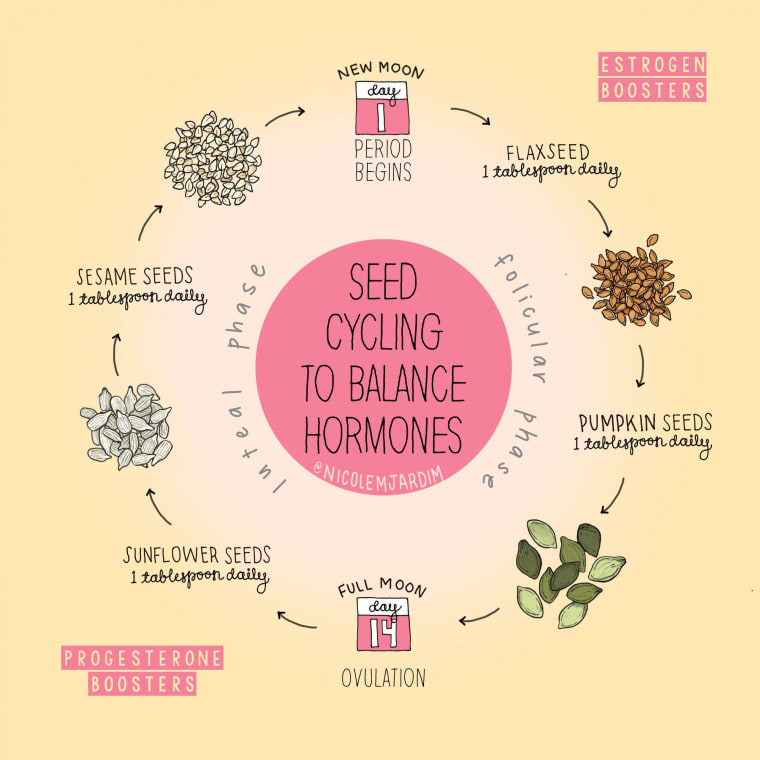
Seed cycling is a technique that — in addition to food and lifestyle changes — naturally helps your body regulate its sex hormone levels, namely estrogen and progesterone, by alternating different seeds during the two halves of your menstrual cycle. The concept is simple: you rotate four types of seeds, two per phase, in sync with the natural hormonal rhythm of your cycle.
- Follicular phase (days 1–14 approximately): 1 tablespoon raw ground flaxseed + 1 tablespoon raw pumpkin seeds daily
- Luteal phase (from ovulation to the day before your next period): 1 tablespoon raw sunflower seeds + 1 tablespoon raw sesame seeds daily
The follicular phase seeds support your body as estrogen rises toward ovulation. The luteal phase seeds support your body as progesterone becomes the dominant hormone after ovulation. This is not about flooding your body with plant hormones — it is about providing the specific nutrients your body needs to make, use, and clear hormones efficiently at each stage of your cycle.
The Evidence: What We Know and What Is Anecdotal
I want to be honest with you here, because I think you deserve it. There are no large randomized controlled trials on seed cycling specifically. The practice as a structured protocol is largely based on the known mechanisms of the individual nutrients in these seeds, combined with years of real-world clinical observation. Here is what the science does tell us:
Lignans and Phytoestrogens
Flaxseed and sesame seeds both contain lignans, a class of phytoestrogen found in the seed hulls. Phytoestrogens are plant compounds with a chemical structure similar to estrogen, which means they can bind to estrogen receptors in the body. This is where things get interesting. Flaxseed lignans appear to have a modulating effect on estrogen — when estrogen is too high, they can act as weak competitors at the receptor, blocking more potent estrogens. When estrogen is too low (as it often is in someone who has not been ovulating regularly), they can have a mildly estrogenic effect. This two-directional action is why flax shows up in research on both estrogen dominance and estrogen deficiency.
Zinc and Follicular Development
Pumpkin seeds are one of the best food sources of zinc. This mineral is critical for follicle maturation in the ovaries each month. Zinc also supports thyroid hormone production, helps manage insulin sensitivity (relevant for PCOS), reduces inflammation and period pain, and is involved in the production of estrogen itself. Including zinc-rich seeds in the follicular phase, when follicles are developing and estrogen is rising, is nutritionally logical.
Selenium and the Corpus Luteum
Sunflower seeds are a good source of selenium. This mineral is found in particularly high concentrations in healthy egg follicles, and it plays a critical role in the later stages of follicle development and ovulation. Importantly, selenium supports the function of the corpus luteum — the structure that forms after ovulation and produces the bulk of your progesterone. It also supports thyroid function and liver detoxification, both of which are essential for healthy hormone clearance. Including selenium-rich seeds in the luteal phase, when the corpus luteum is active and progesterone is the dominant hormone, makes good nutritional sense.
Vitamin E and Progesterone
Sunflower seeds are also rich in vitamin E, which functions both as a fat-soluble vitamin and a potent antioxidant. Research suggests vitamin E may support corpus luteum health and progesterone production in the luteal phase. It has also been linked to reductions in period pain and pelvic pain related to endometriosis.
B Vitamins for PMS and Liver Detox
Sesame seeds contain meaningful amounts of B1, B3, and B6. B1 and B3 have been shown to help with PMS symptoms. B6 supports the liver's ability to break down and deactivate estrogen, and supports the ovaries' production of progesterone — making sesame seeds a particularly useful luteal phase food for women dealing with estrogen dominance or short luteal phase issues.
Fiber and Hormone Clearance
All four seeds are high in fiber. This matters more than most people realize: used-up estrogens and other hormones are excreted from the body through the digestive tract, and adequate fiber is essential for that process. Regular bowel movements are one of the most underrated tools for keeping hormones in check.
The honest summary: the mechanisms are plausible and the individual nutrients are well-studied. The specific protocol as a structured rotation has not been tested in clinical trials. Anecdotally — and I have heard from thousands of women on this — many people notice improvements in cycle regularity, PMS, mood, and skin within a few months of consistent seed cycling. Treat it as a supportive food-based tool, not a standalone treatment.
Who Benefits Most from Seed Cycling?
In my experience, seed cycling tends to be most helpful for:
- Women with irregular cycles — including long cycles, unpredictable cycles, and cycles where ovulation is inconsistent
- Women with PCOS — particularly for supporting follicle development and improving zinc status, which is often low in PCOS
- Women with PMS or PMDD — the B vitamins and zinc in these seeds support mood, reduce inflammation, and help the liver clear excess estrogen
- Women with a short luteal phase or low progesterone — the luteal phase seeds specifically support the corpus luteum and progesterone production
- Perimenopausal women — as cycles become less predictable and hormone production shifts, seed cycling provides consistent nutritional support for estrogen and progesterone balance
- Women recovering from hormonal birth control — particularly those whose cycles have been slow to return or normalize after stopping
Seed cycling is safe for virtually everyone. It is just food. If you are allergic to one of the four seeds, simply skip that seed and continue with the others.
The Full Protocol: Regular Cycles
For this protocol, I define a regular cycle as one that arrives every 25 to 45 days. If your period comes more or less predictably within that range, this is the protocol for you.
If you have a regular period, I recommend tracking your ovulation so you can switch seeds at the right time. Signs of ovulation to watch for include changes in cervical fluid (becomes clear, slippery, and stretchy in the days before ovulation), a sustained rise in basal body temperature, and sometimes a brief cramp or bloating sensation at ovulation. You can also use over-the-counter LH test strips.
Phase 1 — Follicular Phase (Day 1 of Period Through Ovulation)
Start on day 1 of your period and continue until the day you ovulate.
- 1 tablespoon organic, raw, freshly ground flaxseed
- 1 tablespoon organic, raw pumpkin seeds
Phase 2 — Luteal Phase (Day After Ovulation Through Last Day Before Period)
Switch to these seeds the day after you ovulate. For example, if you ovulate on day 17, take the phase 1 seeds through day 17, then switch to phase 2 seeds starting on day 18 and continue until the day before your period arrives.
- 1 tablespoon organic, raw sunflower seeds
- 1 tablespoon organic, raw sesame seeds
When your next period arrives, start over with the phase 1 seeds on day 1.
The Full Protocol: Irregular Cycles, Missing Period, or No Period
If your cycle is longer than 45 days, feels completely unpredictable, or if your period is missing, you will sync with the moon cycle instead of your menstrual cycle. The lunar cycle is approximately 28 days and provides a consistent external rhythm to follow.
Think of it this way: the new moon corresponds to the follicular phase and the full moon corresponds to ovulation/luteal phase. This is not mystical — it is just a reliable 28-day clock you can use while your body's own rhythm is re-establishing itself.
Phase 1 — New Moon to Full Moon (Approximately 14 Days)
Start on the day of the new moon. If you have an irregular cycle and do get a period, you can also start on day 1 of your period whenever it arrives.
- 1 tablespoon organic, raw, freshly ground flaxseed
- 1 tablespoon organic, raw pumpkin seeds
Phase 2 — Full Moon to Next New Moon (Approximately 14 Days)
Switch to these seeds on the day of the full moon.
- 1 tablespoon organic, raw sunflower seeds
- 1 tablespoon organic, raw sesame seeds
If your period is missing completely: follow the moon cycle schedule. Start phase 1 seeds on the new moon, switch to phase 2 seeds on the full moon, and start over again with the next new moon. Continue until your period returns. Once it does, start over with phase 1 seeds on day 1 of your period, and continue according to the regular cycle protocol above.
If your cycle is irregular (not completely absent): follow the same moon cycle structure, but whenever your period does arrive, restart the phase 1 seeds on that day. Switch to phase 2 seeds on day 15 of your cycle (even if the full moon has not arrived yet). If your period does not arrive by day 28, switch back to phase 1 seeds and continue until it does.
To stay on track, consider adding moon phases to your Google Calendar, downloading a moon phase app, or printing out a moon phase calendar. Once you get the hang of the rhythm, it becomes second nature.
How to Prepare Your Seeds
How you prepare these seeds matters, and flaxseed in particular requires a little extra attention.
Flaxseed: Always Grind It Fresh
Flaxseed must be ground before consuming — whole flaxseeds pass through the digestive tract largely intact and you lose most of their nutritional benefit. Use a small coffee or spice grinder to grind them. The key rule: only grind a 2-day supply at a time. Ground flaxseed oxidizes quickly and goes rancid fast. Store your freshly ground flax in an airtight container or jar in the refrigerator. Do not buy pre-ground flaxseed meal that has been sitting on a shelf — the beneficial fats and lignans will have degraded significantly.
The Other Three Seeds
Pumpkin, sunflower, and sesame seeds can be eaten whole. Make sure to chew them thoroughly so your digestive system can break them down properly and you can absorb all those nutrients. You can store these seeds in an airtight container in a cool, dark cupboard, or keep them in the freezer to extend freshness — particularly if you are buying in bulk.
Buying Tips
Look for raw, organic seeds whenever possible. Raw means the seeds have not been roasted or processed, which preserves their heat-sensitive fatty acids and nutrients. Organic reduces your exposure to pesticide residues. That said — do not let the perfect be the enemy of the good. Conventional seeds are fine if organic is not available or affordable. You can toast the seeds lightly if you strongly prefer the flavor; just do not roast flaxseed before grinding. Storing all your seeds in the freezer (in labeled airtight containers or freezer bags) is the best way to keep them fresh and prevent rancidity, especially in warm climates.
How to Work Seeds Into Your Daily Diet
The easiest approach is to find one or two consistent vehicles for your seeds and stick with them. Here are ideas that work well:
- Stir ground flaxseed into a morning smoothie — it blends in completely and is undetectable
- Sprinkle seeds on oatmeal or hot cereal in the morning
- Add pumpkin or sunflower seeds to a salad in place of croutons
- Mix sesame seeds into stir-fries, grain bowls, or roasted vegetable dishes
- Toast pumpkin, sesame, or sunflower seeds and stir them into soups
- Add any of the seeds to homemade granola or energy balls
- Simply eat them on their own as a small snack
It might take a few weeks to find the routine that works for you, but once you do, fitting in your daily tablespoon becomes automatic. If accountability helps, invite a partner, friend, or family member to try it with you.
Want the full hormone-balancing roadmap?
Seed cycling is one piece of a bigger picture. My book Fix Your Period lays out the complete framework for understanding and addressing the root causes of irregular cycles, PMS, painful periods, and more — with practical, food-first protocols for every major period problem.
Learn About the BookWhat to Expect and the Timeline
Be patient. This is a food-based intervention, not a pharmaceutical, and your hormones did not get imbalanced overnight.
Some women notice subtle shifts within the first cycle — improved mood in the luteal phase, slightly less PMS, better energy around ovulation. These are encouraging signs. But the significant changes — more regular cycles, noticeably lighter periods, reduced cramps, more predictable ovulation — typically take three to four cycles (roughly three to four months) of consistent practice.
A few important notes on expectations:
- Seed cycling is a supportive tool, not a standalone treatment. It works best alongside a nutrient-dense diet, stress management, adequate sleep, and addressing any underlying health conditions.
- Do not stress if you miss a day or are a few days "off" on the timing. These are seeds. They will not throw your hormones into chaos. Just pick up where you are and keep going.
- Everybody responds differently. Some women notice profound changes; others notice modest improvements. Experimentation is part of this process.
- If you have a condition like PCOS, hypothyroidism, or a significantly missing period, seed cycling should complement medical care — not replace it.
A Note on Men and Seed Cycling
Men can benefit from seed cycling too. Since they do not have a menstrual cycle, they follow the moon cycle schedule: phase 1 seeds (flaxseed and pumpkin seeds) from the new moon to the full moon, and phase 2 seeds (sunflower and sesame) from the full moon to the next new moon. The same nutrients — zinc, selenium, vitamin E, B vitamins, and lignans — support male hormone health, testosterone production, thyroid function, and fertility as well. A three- to four-month trial is a reasonable starting point.