If you have ever searched online for natural ways to balance your hormones, regulate your cycle, or improve your fertility, you have almost certainly come across vitex. It shows up in supplement blends, wellness blogs, and practitioner recommendations with remarkable frequency. And yet, despite its popularity, there is a lot of confusion about what vitex actually does in the body, who it is appropriate for, and how to use it correctly.
I want to cut through the noise. This article covers the science behind vitex agnus-castus, the conditions where it has a legitimate role, how to dose and time it properly, and — just as importantly — the situations where you should not use it at all.
What Is Vitex Agnus-Castus?
Vitex agnus-castus goes by several common names: chaste tree berry, chasteberry, monk's pepper, and Abraham's balm. It is the fruit of the Vitex agnus-castus shrub, a plant native to the Mediterranean and Central Asia that has been used medicinally for thousands of years. Ancient Greek and Roman physicians prescribed it; medieval monks used it to suppress libido (hence the name "chaste" tree). Today, it is standardized and sold as a supplement specifically for menstrual and hormonal support.
Unlike herbs that act directly on the ovaries or uterus, vitex works upstream — at the level of the brain. This distinction matters a great deal for understanding both why it works and why it can go wrong when used carelessly.
How Vitex Works in the Body
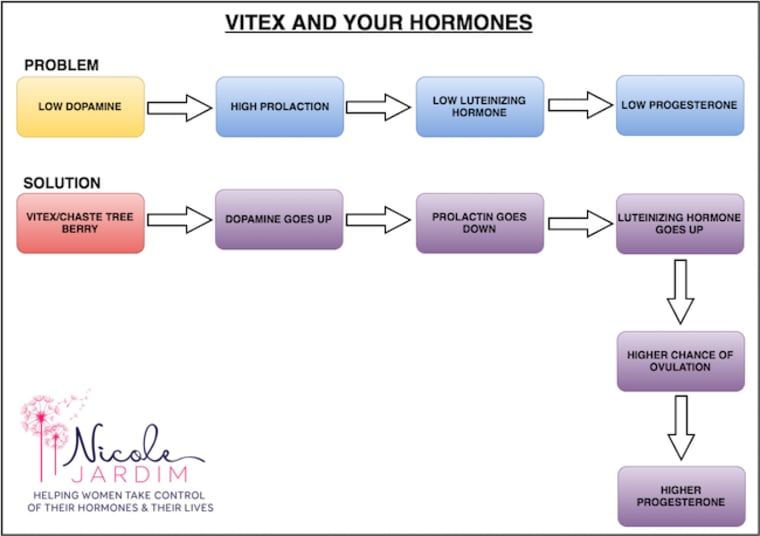
The primary mechanism behind vitex is dopamine agonism. Compounds in the berry — primarily diterpenes — bind to dopamine receptors in the pituitary gland. When dopamine activity at the pituitary increases, it suppresses the release of prolactin.
Why does that matter for your cycle? Prolactin is a hormone that, when chronically elevated, directly inhibits ovulation. It does this by interfering with the release of GnRH from the hypothalamus, which in turn suppresses FSH and LH — the hormones that drive follicle development and trigger ovulation. When ovulation is suppressed or irregular, progesterone production is low by definition, because progesterone is made almost exclusively by the corpus luteum after ovulation occurs.
So here is the chain: vitex raises dopamine → dopamine lowers prolactin → lower prolactin removes a brake on the hypothalamic-pituitary-ovarian axis → ovulation becomes more consistent → the corpus luteum can function properly → progesterone production improves.
Vitex does not contain plant hormones, and it does not act directly on the ovaries to produce progesterone. Its effect on progesterone is entirely indirect — it works by supporting the conditions that allow your body to ovulate properly and make its own progesterone. This is an important nuance that many supplement labels and wellness articles gloss over.
Some research also suggests that vitex has mild opioid receptor activity, which may contribute to its effect on PMS symptoms like mood changes, breast tenderness, and irritability. There is also evidence of weak estrogenic activity in some of its compounds, though the clinical significance of this remains debated.
What Conditions Does Vitex Help With?
Given its mechanism of action, vitex is most likely to be useful in situations where high prolactin or insufficient LH signaling is contributing to hormonal imbalance. The conditions with the strongest evidence include:
Short Luteal Phase (Luteal Phase Deficiency)
A short luteal phase — typically defined as 9 days or fewer between ovulation and the start of your next period — is often a sign that the corpus luteum is not producing adequate progesterone. Because vitex supports more consistent ovulation and better LH activity, it has been shown in clinical studies to help lengthen the luteal phase and improve progesterone levels in the second half of the cycle.
PMS and PMDD
Several randomized controlled trials have found vitex to be more effective than placebo for reducing PMS symptoms including irritability, mood swings, breast tenderness, bloating, and headaches. One well-known trial compared vitex to fluoxetine (Prozac) in women with PMDD and found both to be similarly effective, with vitex performing better specifically for the physical symptoms of PMDD.
Coming Off Hormonal Birth Control
After stopping hormonal contraceptives, it can take months for the hypothalamic-pituitary-ovarian axis to resume normal signaling. During this recovery period, prolactin levels can be dysregulated and ovulation can be delayed or absent. Vitex is one of the most commonly used herbs to support this transition, and many practitioners — myself included — find it helpful for women trying to restore a regular cycle post-pill. Keep in mind, however, that vitex should only be started after stopping hormonal birth control, not while still using it.
Irregular Cycles and Amenorrhea (Selected Cases)
For women with absent or highly irregular periods who are not ovulating, vitex may help re-establish more regular ovulatory cycles — but only if the root cause is amenable to dopaminergic support. If the absence of a period is driven primarily by hypothalamic suppression from undereating, over-exercising, or extreme stress, addressing those root causes must come first. Vitex is not a substitute for adequate nourishment and recovery.
PCOS (Certain Presentations)
The picture here is more complicated. PCOS is not a single condition — it encompasses several different hormonal patterns, and not all of them respond well to vitex. Women with PCOS who have elevated prolactin contributing to their cycle disruption may benefit. However, for women with PCOS who already have high LH relative to FSH, vitex could potentially worsen the hormonal imbalance. This is one situation where I would strongly recommend working with a practitioner before starting vitex rather than self-prescribing.
Dosing and Timing: Getting It Right
Vitex is an herb where getting the details right matters. Here is what the evidence and clinical experience support:
Form
Choose a standardized extract rather than a non-standardized whole berry powder. Standardized extracts ensure a consistent, measurable dose of the active compounds. Look for products standardized to 0.5% agnusides or 0.6% aucubin, which are the primary active markers used in most research.
Dose
The typical therapeutic dose of a standardized extract is 20–40 mg per day. If you are using a whole berry powder or capsule, the equivalent dose is generally 500 mg per day, which can be increased to 1,000 mg daily if you see no effect after the first month. Do not exceed 1,000 mg without guidance from a practitioner.
Timing
Take vitex first thing in the morning, before food. This timing matters because prolactin levels follow a diurnal rhythm — they are highest in the early morning hours — and taking vitex at this time aligns the herb's dopaminergic effect with when it is most needed.
When in Your Cycle to Take It
If you have a menstrual cycle, begin vitex on day 5 of your cycle (five days after bleeding starts) and continue through the end of the cycle, stopping on day 1 of your next period. If you do not currently have a period, you can take vitex continuously until your cycle is re-established, at which point you transition to the cyclic approach.
How Long to Take It
This is where a lot of women go wrong: they try vitex for three or four weeks, see minimal change, and conclude it does not work. Vitex requires a minimum of three months to produce meaningful results, and the full benefit is often not seen until the six-month mark. Hormonal regulation through this mechanism is a slow process — the herb is nudging the hypothalamic-pituitary axis toward better function, not overriding it with an immediate hormonal signal.
The typical recommended timeframe is 3 to 6 months. After that, reassess your symptoms. If you are seeing good improvement, you can taper off and monitor whether your cycle maintains its regularity without supplemental support.
Get your personalized hormonal health protocol
Take the free Hormone Health Assessment — 30 questions about your cycle, symptoms, and lifestyle — and receive a tailored action plan built for your body.
Take the Free Assessment →What to Expect in the First Few Months
One of the most important things to know before starting vitex is that your cycle may get worse before it gets better. Some women notice increased spotting, heavier flow, or more pronounced PMS in the first one to two months of use. This is generally a sign that the herb is initiating a shift in hormonal patterns, not that it is causing harm. That said, if these effects are severe or you experience significant mood depression, stop the herb and consult a practitioner.
Other common initial effects include mild nausea (usually resolved by taking it with a small amount of food), minor acne flares, and temporary changes in cycle length as your body adjusts. These effects typically resolve by the end of the second or third month.
If you are going to use vitex, I recommend building the foundation first. Start with the dietary and lifestyle changes that support healthy ovulation — stable blood sugar, adequate nutrients, stress management, gut health. Give those interventions at least 90 days. If your cycle is still not where you want it to be, then consider adding vitex as the next step, not the first one.
Who Should NOT Take Vitex
Vitex is a powerful adaptogenic herb with real physiological effects. It is not appropriate for everyone, and using it in the wrong situation can make things worse rather than better. Please do not take vitex if any of the following apply to you:
- You are currently using hormonal contraceptives — including the combined pill, progestin-only pill, hormonal IUDs (Mirena, Skyla, Kyleena), the patch, the ring, or injectable contraceptives. Vitex and hormonal birth control work through competing mechanisms, and the combination is both unpredictable and counterproductive.
- You are pregnant or trying to conceive and are in early pregnancy — vitex has historically been used to support conception due to its progesterone-supporting effects, but it should be discontinued as soon as a positive pregnancy test is confirmed. There is insufficient safety data on its use during pregnancy, and some evidence suggests it may interfere with the hormonal support needed in early pregnancy.
- You have a history of estrogen-sensitive conditions — such as estrogen-receptor-positive breast cancer, uterine cancer, endometriosis, or uterine fibroids — due to the herb's potential weak estrogenic activity. Consult an oncologist or specialist before using vitex in any of these cases.
- You are taking dopamine-related medications — including antipsychotics (which block dopamine receptors) or dopamine agonists like those prescribed for Parkinson's disease or restless leg syndrome. Vitex's dopaminergic activity can interfere with these medications.
- You are taking SSRIs or antidepressants — the interaction between vitex's opioid receptor activity and serotonergic medications is not well characterized, and I recommend getting clearance from your prescribing doctor before adding vitex.
- You have pituitary tumors or known hyperprolactinemia from a structural cause — in these cases, the elevated prolactin needs to be addressed medically, and vitex is not an appropriate replacement for appropriate diagnosis and treatment.
- You have PCOS with high LH — as noted above, vitex may worsen the LH imbalance characteristic of this PCOS presentation. Get proper hormonal testing and work with a practitioner.
Even if none of the above apply to you, I always recommend consulting with a healthcare provider before starting vitex, particularly if you are managing any chronic health condition or taking prescription medications.
When to Stop Vitex
Stop vitex and seek guidance if you experience persistent depressed mood, significant worsening of acne, dramatic changes to your cycle that do not resolve within two to three months, or any symptoms that feel genuinely alarming to you. Vitex is generally considered safe within the parameters described here, but it is not a benign supplement to take indefinitely without reassessment.
Once you have achieved your goal — whether that is a regular cycle, a lengthened luteal phase, or resolution of PMS — taper off vitex over two to four weeks rather than stopping abruptly, and monitor your cycle to see whether the improvements are self-sustaining. The goal is always to restore your body's own capacity to produce hormones in balance, not to become dependent on a supplement to maintain that balance.
The Bigger Picture
Vitex works best when it is part of a broader approach to hormonal health — not when it is grabbed off a shelf as a quick fix. The women I have seen benefit most from it are those who have already done the foundational work: eating in a way that supports ovulation, managing blood sugar, reducing their stress burden, and addressing any gut issues that might be affecting nutrient absorption and estrogen metabolism.
If you have not addressed those foundations yet, vitex will have less to work with. And if your low progesterone or cycle irregularity is being driven by a condition like thyroid disease, significant insulin resistance, or hypothalamic amenorrhea, vitex alone will not solve the problem. It needs to be part of the right strategy, not a substitute for one.
Used correctly, with appropriate expectations and in the right context, vitex agnus-castus can be a genuinely useful tool for hormonal health. Used carelessly, it can complicate an already complex picture. The difference comes down to understanding what your body actually needs — which starts with understanding your cycle.