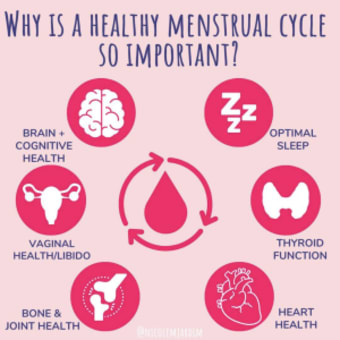
Most of us women were handed a pad or tampon in middle school and told periods are a normal part of being a woman. Full stop. What we were rarely told — and what has taken decades of research to bring into mainstream conversation — is that the menstrual cycle is one of the most information-rich systems in the human body.
Your cycle can reveal how well your thyroid is functioning, whether you're under too much stress, if your blood sugar is unstable, and whether your immune system is struggling with something it hasn't yet named. It is, as the American College of Obstetricians and Gynecologists formally recognized in 2015, a vital sign — as meaningful as heart rate or blood pressure.
This guide covers everything you should have been taught at the start: what the menstrual cycle actually is, how the four phases work, the key hormones involved, what normal looks like, and how to use your cycle as a window into your health.
What Is the Menstrual Cycle?
Here's the first thing most people get wrong: the menstrual cycle is not your period. Your period is just one phase of a much longer, much more complex process. The menstrual cycle encompasses everything from the first day of one period to the first day of the next — and a great deal happens in between.
A typical cycle runs anywhere from 21 to 35 days, with 28 days often cited as the average (though many healthy cycles differ from this). Throughout the cycle, the brain, ovaries, uterus, and cervix are in constant hormonal conversation — a precisely timed feedback loop involving at least five major hormones that rise and fall in coordinated waves.
The purpose of this cycle is not simply reproduction, although that is one of its functions. Regular ovulation — the cycle's main event — drives the production of estrogen and progesterone that your brain, bones, heart, skin, and mood all depend on. When you ovulate consistently, your hormones are working as they should. When ovulation is disrupted, everything downstream is affected.
This is why understanding your cycle is not just reproductive health. It is whole-body health.
The Four Phases of the Menstrual Cycle
The menstrual cycle is divided into four phases. Two of them — menstruation and the follicular phase — overlap in the first half of the cycle. The second half belongs entirely to the luteal phase. In the middle sits the brief but pivotal ovulatory phase, which is the event the entire cycle is building toward.
Menstruation
The uterine lining sheds as estrogen and progesterone fall to their lowest point. Day 1 of bleeding is officially Day 1 of your cycle.
Follicular Phase
Overlaps with menstruation. Estrogen rises as follicles develop in the ovaries, building toward ovulation. The length of this phase determines total cycle length.
Ovulation
A surge of LH triggers the release of a mature egg. The shortest phase — just 24–48 hours — but the most hormonally significant event of the entire cycle.
Luteal Phase
Progesterone dominates as the body prepares for possible pregnancy. If no fertilization occurs, progesterone drops and menstruation begins again.
Phase 1: Menstruation (Days 1–5)
Menstruation begins on Day 1 of your cycle — the first day of full flow, not spotting. It's triggered by the drop in progesterone at the end of the previous luteal phase, which signals the uterine lining that it's time to shed. Estrogen is also at its lowest right now, though it will begin rising within days.
On average, a period lasts 3 to 7 days. Flow should be manageable — not so light that it disappears in a day, not so heavy that you're soaking through protection every hour. Many people experience mild cramping as the uterine muscles contract to expel the lining, but pain that disrupts your daily life is not something to accept as normal.
While menstruation gets all the attention, something equally important is happening in the ovaries during this time. The pituitary gland is already secreting follicle-stimulating hormone (FSH) to begin recruiting a new cohort of follicles for the upcoming cycle. The next ovulation is already in motion before your period ends.
What your blood color tells you
Bright red: Typically indicates healthy circulation and adequate estrogen. This is what most of your period flow should look like.
Dark brown or almost black: Usually old blood that took longer to leave the uterus. Common at the very start or end of a period. If it's your predominant flow color, it can suggest low progesterone or slow uterine contractions.
Light pink or watery: Can indicate low estrogen levels — worth noting if it's consistently how your period looks, especially if combined with a light, short flow.
Grey: This is not normal. Grey discharge or tissue during a period can be a sign of infection and warrants prompt medical attention.
Phase 2: The Follicular Phase (Days 1–13)
The follicular phase begins on Day 1 of your period and continues until ovulation — so it overlaps entirely with menstruation for the first several days. It's named for what's happening in the ovaries: FSH is stimulating a group of follicles to develop, each containing a single egg. Eventually, one dominant follicle pulls ahead while the others disintegrate.
As the dominant follicle grows, it produces rising amounts of estradiol (the body's most potent form of estrogen). This estrogen does several things simultaneously: it thickens and vascularizes the uterine lining in preparation for a possible pregnancy, it causes the cervix to soften and rise, and it begins transforming cervical fluid from absent or sticky to increasingly wet and slippery.
The length of the follicular phase is what determines how long your overall cycle is. A longer follicular phase means a longer cycle. Once ovulation happens, the luteal phase that follows is relatively fixed at around 12–14 days for most people — so if your period is "late," it almost always means ovulation was delayed, not that your luteal phase stretched.
As estradiol rises to a critical threshold — staying above approximately 200 pg/mL for about 50 hours — it triggers the pituitary to release a large surge of luteinizing hormone (LH). This is the signal that kicks off ovulation.
Phase 3: Ovulation (Around Day 14)
Ovulation is the main event of the menstrual cycle. It is not your period. Everything the follicular phase built toward — the rising estrogen, the maturing follicle, the accumulating LH — culminates in this single moment: a mature egg is released from the dominant follicle and swept into the fallopian tube.
The LH surge begins about 35–44 hours before ovulation and typically occurs between midnight and 8am. The entire ovulatory process — from surge to egg release — lasts roughly 24–48 hours. The released egg is viable for just 12–24 hours.
At this point, cervical fluid transforms into its most fertile state: clear, stretchy, and highly elastic — often described as resembling raw egg white. This fluid nourishes sperm, protects them from the vagina's natural acidity, and contains microscopic channels that guide them toward the egg. It's one of the most reliable signs you can observe to identify your fertile window.
Some people feel a mild twinge or ache on one side of the lower abdomen at ovulation — this is called mittelschmerz (German for "middle pain") and is caused by the follicle rupturing. A sharp or severe pain at ovulation, however, can indicate inflammation, endometriosis, or ovarian cysts, and is worth investigating.
Why does ovulation matter beyond fertility? Because ovulation is what triggers the formation of the corpus luteum — the temporary endocrine gland that produces progesterone. Without ovulation, there is no meaningful progesterone production. And without progesterone, the downstream effects on mood, sleep, bone density, breast health, and cycle regularity are significant. You can have a period without ovulating, but that cycle is missing the hormonal backbone that protects your health.
Phase 4: The Luteal Phase (Days 15–28)
Once the egg is released, the ruptured follicle transforms into a remarkable structure called the corpus luteum — literally "yellow body," named for the carotenoid pigment it contains. This temporary endocrine gland, formed in under 24 hours and measuring 2–5 centimeters, is the primary source of progesterone for the second half of your cycle.
Progesterone's job is to prepare the uterine lining for a potential embryo, raise basal body temperature (which is why your temperature is measurably higher after ovulation), and transform cervical fluid from fertile and slippery to thick and tacky — creating a natural barrier against new sperm. It also has a calming, anti-anxiety effect on the brain, which is partly why low progesterone is associated with anxiety, poor sleep, and worsening PMS.
The luteal phase typically lasts 11–17 days, with most people falling around 12–14 days. A luteal phase shorter than 10 days — called luteal phase deficiency — means the corpus luteum is breaking down too quickly, producing insufficient progesterone. This can cause premenstrual spotting, PMS that arrives too early, difficulty conceiving, and cycles that feel "off."
In the second week of the luteal phase, estrogen makes a second, smaller rise — a last effort to further prepare the uterine lining. If fertilization does not occur, the corpus luteum breaks down around days 9–11 after ovulation. Progesterone and estrogen fall sharply. The uterine lining, deprived of hormonal support, begins to shed. Your period arrives, and the cycle begins again.
Not sure where you are in your cycle?
The Hormone Health Assessment takes 30 questions about your symptoms, cycle patterns, and lifestyle — and generates a personalized protocol built around what your body is actually telling you.
Take the Free Assessment →Key Hormones and What They Do
Five hormones do most of the work in your menstrual cycle. Understanding what each one does — and what it signals when it's out of range — is foundational to reading your own cycle clearly.
| Hormone | Primary Role | What disruption looks like |
|---|---|---|
| Estrogen (Estradiol) | Builds the uterine lining; supports follicle development; drives cervical fluid changes; essential for brain, bone, heart, and skin health | Low estrogen: light periods, short cycles, vaginal dryness, poor sleep. Excess estrogen: heavy or clotty periods, breast tenderness, bloating |
| Progesterone | Produced by the corpus luteum after ovulation; supports the uterine lining for implantation; raises basal body temperature; calms the nervous system; protective for breast and uterine health | Low progesterone: PMS, spotting before period, short luteal phase, anxiety, poor sleep, difficulty conceiving |
| FSH (Follicle-Stimulating Hormone) | Released by the pituitary; stimulates ovarian follicle development at the start of each cycle | Elevated FSH (especially on day 2–4) can indicate diminished ovarian reserve. Low FSH can mean the pituitary isn't sending the right signals, often due to stress or undereating |
| LH (Luteinizing Hormone) | The mid-cycle surge triggers ovulation; also stimulates androgen production in the follicle's theca cells | An LH surge without a subsequent temperature rise may indicate the egg didn't release. Chronically elevated LH (high LH:FSH ratio) is a hallmark of many PCOS presentations |
| Testosterone | Present in small amounts; supports libido, energy, and mood; a precursor to estradiol in the follicle | Excess androgens (testosterone, DHEA): acne, excess facial or body hair, thinning scalp hair, irregular or absent ovulation — common in PCOS and some adrenal conditions |
All of these hormones are produced from a common raw material: cholesterol. This is why extremely low-fat diets and severe caloric restriction can impair hormone production — your body simply doesn't have enough building blocks to manufacture adequate sex hormones.
It's also worth knowing that these hormones don't operate in isolation. They work within a tightly regulated feedback loop called the hypothalamic-pituitary-ovarian (HPO) axis. The hypothalamus sends GnRH (gonadotropin-releasing hormone) to the pituitary, which releases FSH and LH, which signal the ovaries to produce estrogen and progesterone, which feed back to the hypothalamus to regulate the next round of signals. This loop can be disrupted by stress hormones (cortisol), blood sugar dysregulation (insulin), and thyroid dysfunction — which is why your menstrual cycle is sensitive to your overall health status.
What's Normal — and What Isn't
One of the most important things I want you to take away from this guide is that many symptoms commonly attributed to "normal periods" are not actually normal. They are common — meaning many people experience them — but common and normal are not the same thing.
Normal cycle parameters
- Cycle length: 21–35 days
- Period length: 3–7 days
- Flow: light to moderate
- Color: mostly bright to medium red
- Small clots (dime-sized or smaller): occasional
- Mild cramping that doesn't stop daily life
- Some PMS in the week before your period
Worth investigating
- Cycles shorter than 21 or longer than 35 days
- Periods lasting fewer than 3 or more than 7 days
- Soaking through a pad or tampon every hour or less
- Clots larger than a quarter
- Pain that requires medication or limits activity
- Spotting between periods or before your period starts
- Cycles that disappear for 3+ months (not pregnancy)
- Severe PMS or PMDD that significantly affects your life
Pain is the most commonly dismissed symptom. Severe period pain — the kind that keeps you home from work or school, that requires prescription medication, or that radiates into your back and legs — is a signal from your body that something is worth investigating. Conditions like endometriosis, adenomyosis, fibroids, and pelvic inflammatory disease can all produce debilitating pain. These are real, diagnosable conditions, and none of them should be managed with "just take ibuprofen."
Heavy bleeding is another commonly normalized symptom. Losing more than 80 mL of blood per period (roughly 16 fully soaked regular tampons or pads) is medically defined as heavy menstrual bleeding. It can indicate fibroids, polyps, adenomyosis, thyroid dysfunction, or a coagulation disorder — all of which are treatable once identified. Heavy periods also frequently lead to iron deficiency, which adds fatigue, brain fog, and breathlessness to the picture.
If any of the "worth investigating" symptoms apply to you consistently, the goal isn't to find a way to push through — it's to understand what your body is communicating and address it at the root. Want to dig deeper into a specific symptom? Browse the full article library for in-depth guides on each of these topics.
Your Cycle as a Vital Sign
In 2015, the American College of Obstetricians and Gynecologists formally recommended that the menstrual cycle be considered a vital sign — alongside temperature, heart rate, blood pressure, and respiratory rate — in adolescents. I extend that recommendation to people at every age of their reproductive life.
The reason is straightforward: the menstrual cycle is downstream of virtually every major system in the body. When something goes wrong upstream — in the thyroid, the adrenal glands, the gut, the immune system, the brain — the menstrual cycle is often one of the first places the disruption shows up. A cycle that was regular and suddenly becomes erratic is telling you something changed. A cycle that has always been painful is telling you something has always needed attention.
Here are some examples of what cycle changes can signal:
- Sudden missed or very late periods (not pregnancy): Often signals significant stress, undereating, or a new thyroid or metabolic issue. The body's first priority under stress is survival — reproduction is deprioritized.
- Heavier periods with more clots: Can indicate thyroid dysfunction, fibroids, or estrogen excess relative to progesterone — sometimes linked to gut or liver issues affecting hormone clearance.
- Increasingly shorter cycles: A shortening cycle (especially if moving below 24 days) can be an early indicator of declining ovarian reserve, thyroid dysfunction, or PCOS.
- Worsening PMS, especially anxiety and mood shifts: Often points to low progesterone in the luteal phase, which can be tied to stress, nutritional deficiencies, or insufficient ovulation.
- Very light or short periods: Can reflect low estrogen, undereating, excessive exercise, or thyroid hypofunction.
None of these patterns are your body malfunctioning. They are your body communicating — sometimes loudly, sometimes subtly — that something in your environment or physiology has shifted. Learning to read these signals, rather than suppress them with hormonal contraception or simply white-knuckle through them, is the foundation of everything in the Fix Your Period approach.
Your cycle isn't a problem to be managed. It's information to be understood.
Ready to learn more? Explore related in-depth guides:
- 5 Things That Can Stop Ovulation and Impair Fertility
- How to Lengthen Your Luteal Phase and Raise Progesterone
- The Real Reason Your Breasts Are Sore Before Your Period
- PCOS, High Prolactin, and Primary Ovarian Insufficiency
- How to Track Your Cycle — Apps, Tools, and What to Monitor
Get your personalized hormonal health protocol
Take the free Hormone Health Assessment — 30 questions about your cycle, symptoms, and lifestyle — and receive a tailored action plan built for your body.
Take the Free Assessment →